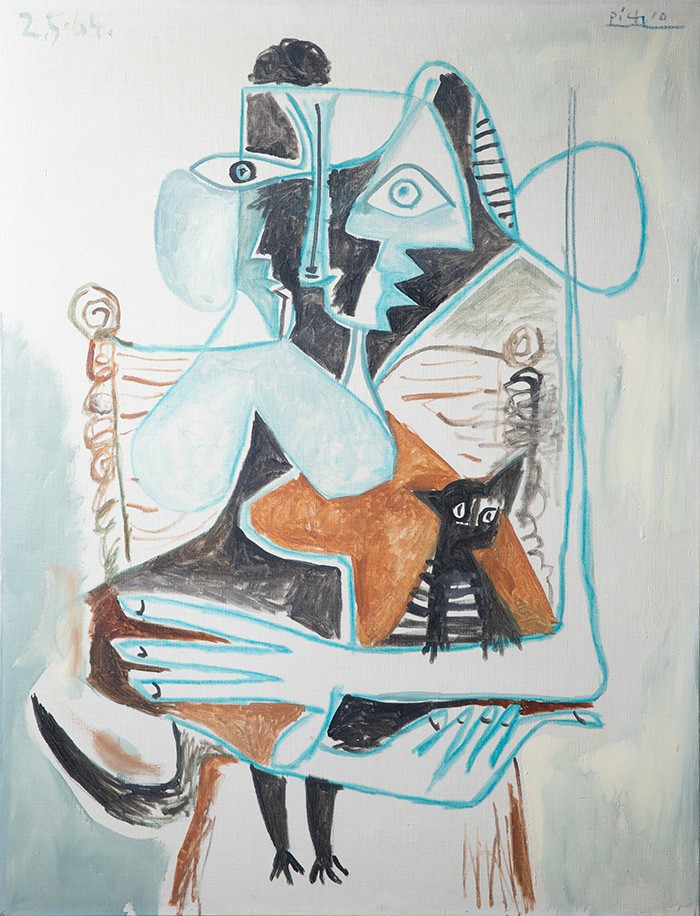
Pablo Picasso, Femme tenant un chat dans ses bras, 1964
07 May 2026
Pablo Picasso’s Femme tenant un chat dans ses bras (Woman Holding a Cat in Her Arms), dated 2 May 1964, is a late-period oil on canvas that exemplifies the remarkable vitality of the artist’s work in his eighties. It belongs to a broader series of canvases from 1964 in which Picasso repeatedly depicted women with a cat—a motif he pursued with notable intensity over a short period.
Created at Notre-Dame-de-Vie, Picasso’s villa in Mougins, France, the series has a clearly autobiographical context: in early 1964, Picasso and his wife Jacqueline Roque encountered a small black cat in their garden, which became a frequent motif in his studio practice that spring. These feline-infused compositions vary between reclining nudes and seated portraits, with the animal often interacting closely with the female subject.
In the context of Picasso’s oeuvre, the Femme tenant un chat paintings represent the artist’s enduring engagement with figurative representation late in life. Picasso had continually reinvented his style throughout his career—from his Blue and Rose Periods to Cubism, Neoclassicism, and Surrealism—but by the 1960s he was operating in a mode that freely integrated references, simplifications, and expressive distortions. In this series, he combines a direct figuration of the female figure with a playful, almost symbolic use of the cat, recalling earlier works in his career that also paired women and felines.
These works are significant because they demonstrate that Picasso’s creativity did not abate with age; rather, he continued to produce substantial, large-scale oil paintings with fresh energy and thematic variety well into his eighties. They sit alongside other beloved late works such as Femme au chat assise dans un fauteuil (1964), which attest to his sustained technical virtuosity and visual inventiveness.
This piece operates somewhere between intimate portraiture and symbolic metaphor. Unlike overtly narrative works that tell a specific story, this painting conveys mood, presence, and psychological tension through its composition and the relationship between woman and cat. The cat, while it may echo the erotic or mysterious associations found in European art as with Manet’s Olympia, is also rooted in Picasso’s immediate life and environment.
The female figure in this painting is understood to be Jacqueline Roque, Picasso’s second wife and principal muse during his final decades. Roque appears throughout his late works, often in powerful seated or full-figure portraits. The cat, introduced into the artist’s studio by chance, enhances the personal, autobiographical dimension of these images without anchoring them to a traditional narrative.
This artwork will be featured in the upcoming Opera Gallery exhibition 'Regards sur l'art espagnol, 1945-2025' in Paris from 22 May to 17 June 2026.