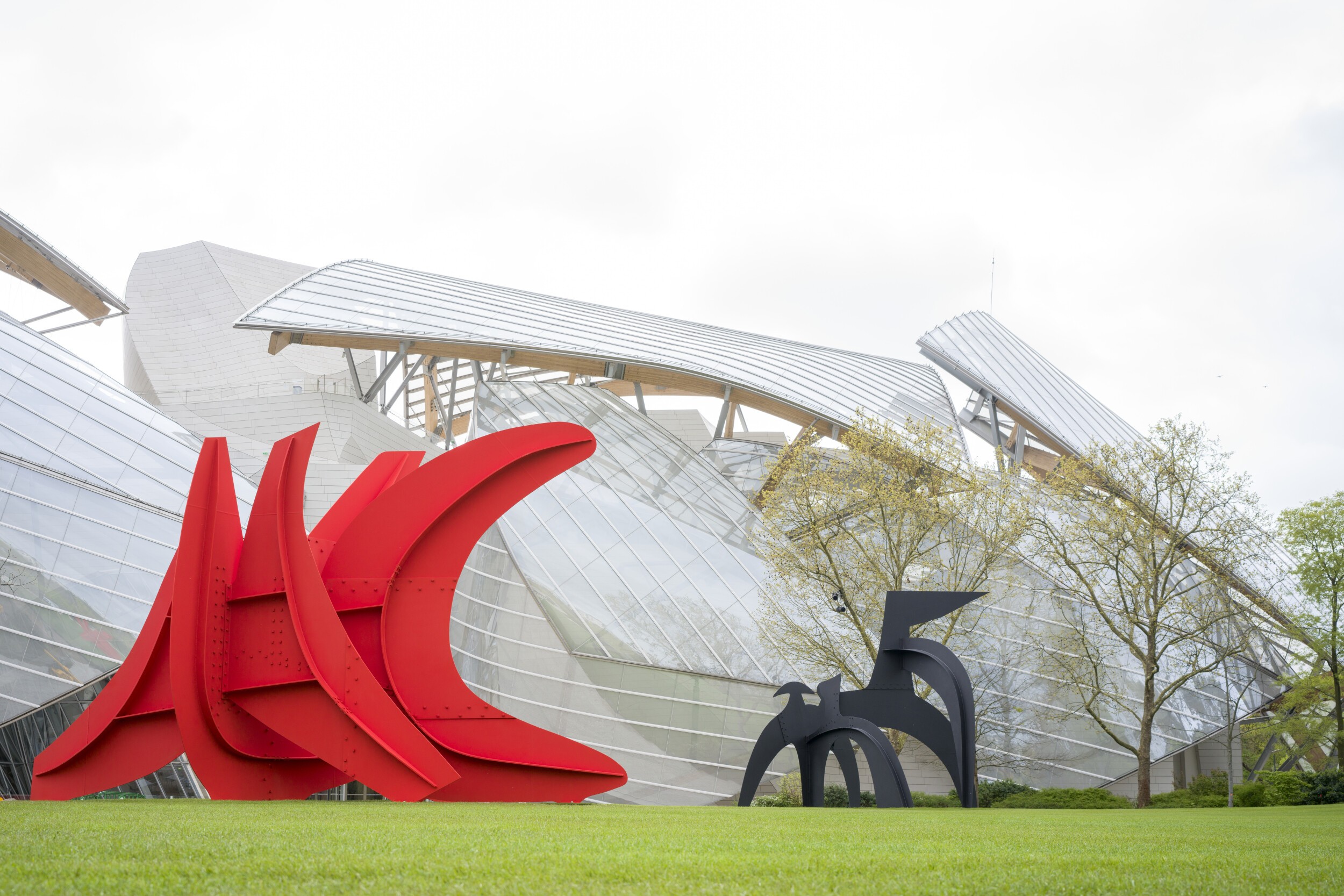
‘Calder: Rêver en équilibre’ at Fondation Louis Vuitton
Paris, France
07 May 2026
At Fondation Louis Vuitton, ‘Calder: Rêver en équilibre’ on view from 15 April to 16 August 2026, offers a major retrospective of Alexander Calder, marking both the centenary of his arrival in France and fifty years since his death. Conceived in collaboration with the Calder Foundation, the exhibition brings together nearly 300 works spanning five decades, positioning it among the most comprehensive presentations of the artist to date.
Structured chronologically, the exhibition traces Calder’s evolution from the late 1920s to the 1970s. Early works include the celebrated Cirque Calder, a performative miniature circus that captivated the Parisian avant-garde. These experiments in movement and spectacle anticipate the radical shift that followed Calder’s encounter with Piet Mondrian in 1930, prompting his turn towards abstraction and the development of kinetic sculpture.
Central to the exhibition is Calder’s invention of the mobile—named by Marcel Duchamp—and its static counterpart, the stabile, a term coined by Jean Arp. Suspended within the fluid volumes of Frank Gehry’s architecture, these works activate the gallery space, transforming it into what the curators describe as a choreographed environment. Movement, gravity and balance are treated not merely as formal concerns but as structuring principles, extending sculpture into time as a “fourth dimension”.
The exhibition foregrounds the breadth of Calder’s practice beyond his iconic mobiles. Wire portraits, carved wooden figures, paintings, drawings and jewellery reveal an engagement with line, volume and material. Recurring themes—light, sound, ephemerality and the interplay between positive and negative space—underscore a practice rooted in experimentation and responsiveness to the physical world.
‘Rêver en équilibre’ situates Calder within a wider avant-garde network. Works by contemporaries including Barbara Hepworth, Jean Hélion, Paul Klee and Pablo Picasso contextualise his innovations, while photographs by figures such as Henri Cartier-Bresson and Man Ray offer insight into the artist’s life and working process.